


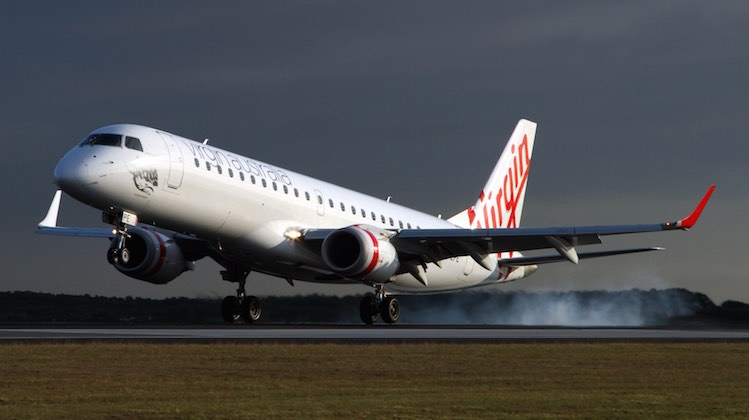
Virgin Australia says it plans to work its fleet harder in calendar 2016 after announcing the withdrawal of five Embraer E190s, as the airline group reaffirmed a return to profitability for the full 2015/16 financial year.
The 98-seat E190 fleet will be reduced to 13, from 18 currently, by September 2016, Virgin said in its 2015/16 first half financial results on Thursday.
The E190 disposals would be covered through increased utilisation of the airline’s Boeing 737-800 fleet, Virgin said.
Virgin also announced it would sell its six Embraer E170s which were currently sub-leased to alliance partner Delta Air Lines.
And the company said Virgin Australia Regional Airlines’ (VARA) Fokker 50s, which the airline put up for sale in October 2015, will be gone by the end of 2015/16.
The fleet optimisation initiatives were part of the airline group’s cost reduction program, as well helping pay down debt and improve fleet utilisation, Virgin said. The airline is targeting $1.2 billion in cumulative cost savings by the end of 2016/17.
The company has also brought back in-house line maintenance of its ATR turboprops and signed anew engine maintenance contract with Delta Air Lines for the 737 fleet.
As previously disclosed in its second quarter financial results, Virgin posted a welcome return to the black in the six months to December 31 2015 with net profit coming in at $62.5 million, compared with a $47.8 million statutory net loss in the prior corresponding period.
Virgin said it was the strongest net profit result since the first half of 2009/10.
Underlying profit before tax, which removes one-off items and was the airline’s preferred indicator of financial performance, rose to $81.5 million in the half, compared with $10.2 million a year ago.
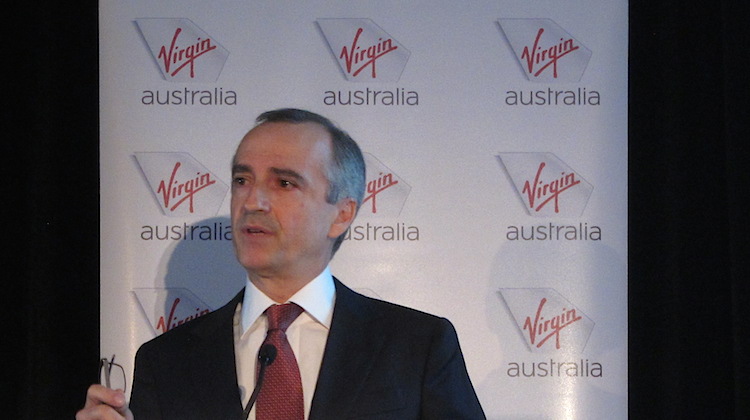
Virgin Australia chief executive John Borghetti presenting the 2015/16 first half results. (Jordan Chong)
Virgin’s domestic operations, Tigerair Australia and Velocity frequent flyer program all made a positive contribution to the overall result.
And while Virgin’s international flying continued to remain a loss-making part of the business, its financial results did improve from the prior corresponding half and would have been better had it not been for the disruptions caused by the Bali ash cloud.
Virgin said it received a $33.8 million net benefit from falling oil prices, including the impact of foreign exchange movements, with further gains expected in the second half. (The Australian dollar dropped about five per cent against the US dollar during the half, although the airlines normally hedge their fuel costs.)
“Virgin Australia Group saw a benefit of approximately $105.9 million from the decline in oil prices in comparison to the first half of the 2015 financial year, due to the nature of the hedging program in place. This was largely offset by a $72.1 million adverse non-fuel foreign exchange cost impact,” Virgin said.
Virgin Australia chief executive John Borghetti said the company was on track for a full year profit, without offering specific earnings guidance.
“The Group’s operational and financial performance continues to show strong momentum across all business units. The Group is improving its revenue and customer offering in all segments of the aviation market. At the same time, the Group is maintaining strict cost discipline while optimising the balance sheet,” Borghetti said in a statement.
“Based on current market conditions, all fundamental business metrics are in place for the Group to report a profit for the 2016 financial year and deliver a Return on Invested Capital in line with its Cost of Capital. However, due to current market conditions, we are not able to provide more specific guidance at this time.”
Virgin’s domestic business posted underlying earnings before interest and tax (EBIT) of $130 million for the half, up strongly from $69.7 million in the prior corresponding period. Revenue per available seat kilometre (RASK) rose 7.1 per cent, while yields were up 9.1 per cent in the half, Virgin said.
“The group is on track to meet its target of 30 per cent of domestic revenue from corporate and government travellers by the end of the 2017 financial year,” Borghetti said.
Meanwhile, the turnaround at its wholly-owned low-cost unit Tigerair continued in the 2015/16 first half, with the airline posting positive underlying EBIT of $13.9 million, compared with a $24.8 million underlying EBIT loss a year earlier. It was Tigerair’s highest half year underlying EBIT, Virgin said, while RASK and yields were also up strongly, rising 9.2 per cent and 12 per cent, respectively.
“The success of the Tigerair Australia turnaround continues to build momentum,” Borghetti said.
On the international front, Virgin’s overseas flying suffered a $30.8 million underlying EBIT loss in the half, up from a loss of $39.5 million previously. Virgin said the disruption from the Bali ash cloud events cost $19.2 million.
The airline’s previously announced initiatives, including increasing seats on trans-Tasman routes,handing over flights to Bali from Melbourne, Adelaide and Perth over to Tigerair, withdrawing from the Perth-Phuket route and reconfiguring of its five Boeing 777-300ERs with a new business class seat and refreshed premium economy cabin would support the turnaround efforts on its international network. Virgin has forecast its international flying will be profitable by 2016/17.
And Velocity has grown its membership base to 5.7 million by December 31 2015, with an average of 2,595 members a day joining the frequent flyer program. Revenue from Velocity rose by $32.2 million to $154.8 million, while underlying EBIT improved to $70.8 million, from $45.2 million.

All Fokker 50s will be retired from the VARA fleet by the end of the financial year. (Rob Finlayson)

Virgin Australia chief executive John Borghetti. (Jordan Chong)
Embraer and Austrian Airlines have signed a Component Pool Program agreement to support the carrier’s fleet of 13 E195 aircraft. Under the agreement, Austrian Airlines will gain access to Embrae...
ALSIM is supporting the advancement of pilot training in Malaysia through ADMAL Flying Academy’s acquisition of an AL250 simulator. The addition of the device will enhance the academy’s Co...
Boston MedFlight, the internationally recognized nonprofit provider of critical care transport services, has signed an agreement with Airbus Helicopters for three new H145 helicopt...
Embraer has appointed FL Technics as an Embraer Authorized Service Center (EASC) for its commercial aircraft fleet in Lithuania. The designation covers the E170 and E190 aircraft, further strengt...