


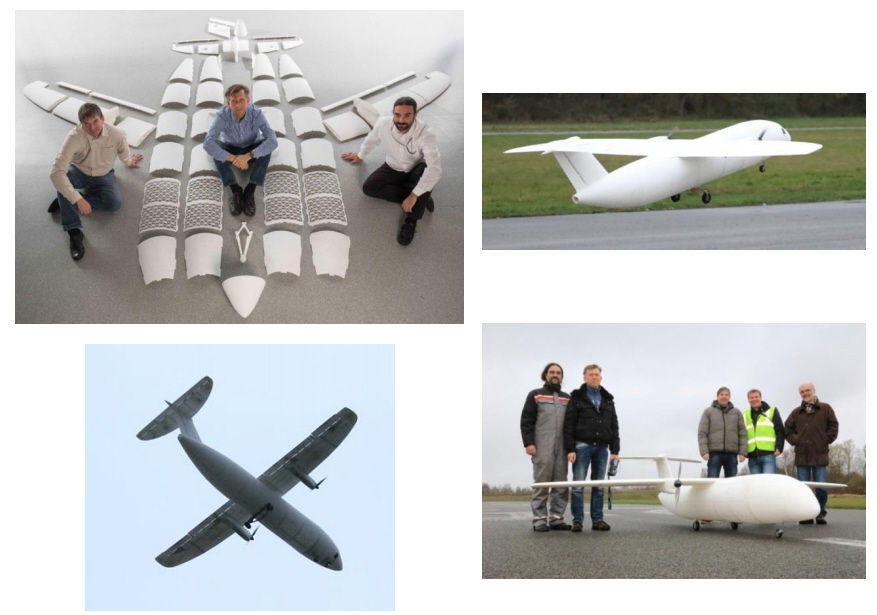
Airbus, the European aerospace giant, has a new drone named Thor. Thor is a clumsy acronym for “Test of High-tech Objectives in Reality,” and what the drone does is nowhere near is important as what it means. The drone, all 13 feet and 55 pounds of it, was 3D printed over the course of about a month.
Unveiled at the 2016 International Aerospace Exhibition and Air Show in Berlin this week, Thor is made of roughly 50 3D printed parts. It is easier to name what in Thor wasn’t printed: some parts of the two engines, and the controls.
Thor had a first successful flight back in November, where it flew for 25 miles. Airbus plans 18 more test missions this year for the aircraft. Should any part break, 3D printing makes replacement easy, and if any part can be improved, it’s easy to print the part to the plane’s design and replace it. It’s the flexibility of 3D printing that Airbus hopes to capitalize on, and regardless of whether or not Thor is useful as an independent product, it’s teaching Airbus engineers what they can do with 3D printed planes. A rough draft of the future, in miniature form.
Archer Aviation Inc. and ITA Airways, Italy’s national carrier and a member of the Lufthansa Group, have entered into a strategic partnership to advance the deployment of an all-e...
FL Technics Indonesia has successfully obtained EASA Part-145 certification for its Bali maintenance facility, authorising the company to perform maintenance on aircraft registered within the European...
The acquisition marks an important step in SITA’s evolution from a provider of aviation connectivity solutions to a driver of smarter operational decision-making. By combining Flightscape’...
Embraer has appointed FL Technics as an Embraer Authorized Service Center (EASC) for its commercial aircraft fleet in Lithuania. The designation covers the E170 and E190 aircraft, further strengt...