


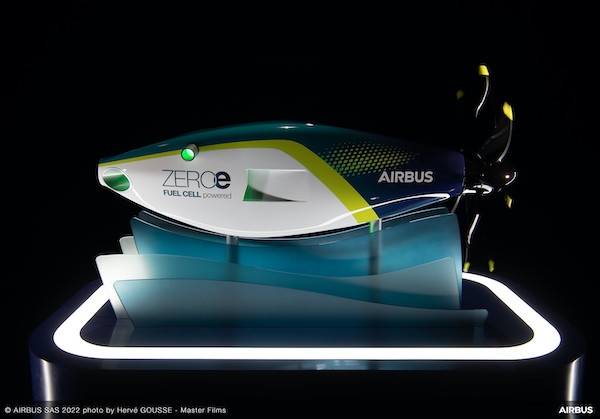
Airbus has revealed that it is developing a hydrogen-powered fuel cell engine. The propulsion system is being considered as one of the potential solutions to equip its zero-emission aircraft that will enter service by 2035. Airbus will start ground and flight testing this fuel cell engine architecture onboard its ZEROe demonstrator aircraft towards the middle of the decade. The A380 MSN1 flight test aircraft for new hydrogen technologies is currently being modified to carry liquid hydrogen tanks and their associated distribution systems.
Glenn Llewellyn, VP Zero-Emission Aircraft, Airbus, commented: “Fuel cells are a potential solution to help us achieve our zero-emission ambition and we are focused on developing and testing this technology to understand if it is feasible and viable for a 2035 entry-into-service of a zero-emission aircraft. At scale, and if the technology targets were achieved, fuel cell engines may be able to power a one hundred passenger aircraft with a range of approximately 1,000 nautical miles. By continuing to invest in this technology we are giving ourselves additional options that will inform our decisions on the architecture of our future ZEROe aircraft, the development of which we intend to launch in the 2027-2028 timeframe.”
Airbus identified hydrogen as one of the most promising alternatives to power a zero-emission aircraft, because it emits no carbon dioxide when generated from renewable energy, with water being its most significant by-products. There are two ways hydrogen can be used as a power source for aircraft propulsion. First via hydrogen combustion in a gas turbine, second, by using fuel cells to convert hydrogen into electricity in order to power a propeller engine. A hydrogen gas turbine can also be coupled with fuel cells instead of batteries in a hybrid-electric architecture.
Hydrogen fuel cells, especially when stacked together, increase their power output allowing scalability. In addition, an engine powered by hydrogen fuel cells produces zero NOx emissions or contrails thereby offering additional decarbonisation benefits.
Airbus has been exploring the possibilities of fuel cell propulsion systems for aviation for some time. In October 2020, Airbus created Aerostack, a joint venture with ElringKlinger, a company with over 20 years of experience as both a fuel cell systems and component supplier. In December 2020, Airbus presented its pod-concept which included six removable fuel cell propeller propulsion systems.
To find more about Airbus' fuel cell engine and demonstrator, click here.
Airbus has launched Alpha Component Solutions, a 50:50 joint venture with Air France dedicated to delivering comprehensive A350 component support services. Jointly operated by Airbus and Air Fran...
Qantas has announced a major investment in its De Havilland Dash 8 turboprop fleet, reinforcing its long-term commitment to maintaining reliable air links across regional Australia. As part...
FL Technics Indonesia has successfully obtained EASA Part-145 certification for its Bali maintenance facility, authorising the company to perform maintenance on aircraft registered within the European...
ALSIM is supporting the advancement of pilot training in Malaysia through ADMAL Flying Academy’s acquisition of an AL250 simulator. The addition of the device will enhance the academy’s Co...