


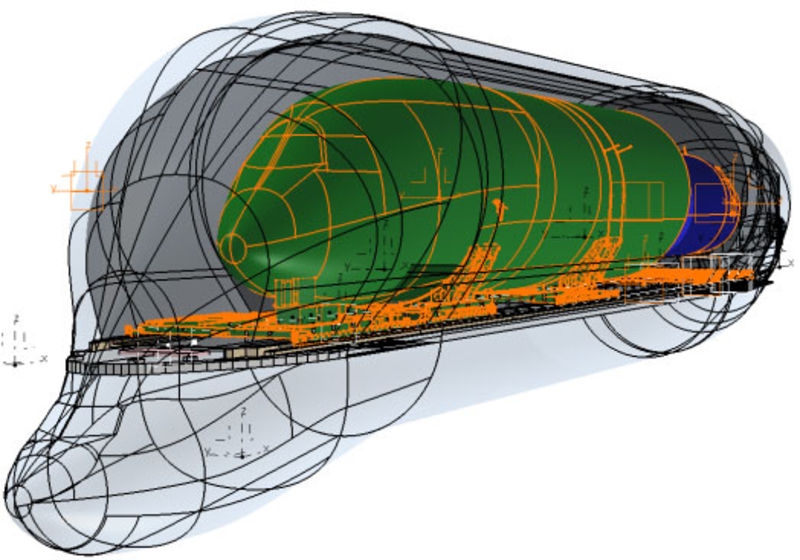
With development of the new Beluga XL airlifter, Airbus is creating a platform tailored to meet its evolving transport needs in the decades to come – particularly to support future production ramp-ups for the company’s range of modern single-aisle and widebody jetliners.
The Beluga XL programme was launched in November 2014, with this oversized transporter to be utilised for carrying complete sections of Airbus aircraft from different production sites around Europe to the final assembly lines in Toulouse, France and Hamburg, Germany.
Based on the airframe of the versatile A330 jetliner, a total of five Beluga XL airlifters are to be built, with the first to enter operational service in mid-2019. They will gradually replace the existing fleet of Beluga ST aircraft, which were derived from the shorter-fuselage A300.
“The Beluga XL is really a patchwork,” said Olivier Delmas, Head of Overall Aircraft Design for the programme, in explaining how elements of two A330 jetliner versions are combined for the Beluga XL. “Geometrically, it is the forward part of an A330-200F freighter, with the aft part of an A330-300 variant.”
A large “bubble” airframe section added to the fuselage’s lower portion takes the Beluga XL’s diameter from 5.6 metres for an A330 up to 8.8 metres. The cockpit has been lowered to make space for a main deck with direct cargo loading/unloading capabilities above it.
Delmas explained this approach was chosen because no existing aircraft answered Airbus’ criteria for a new-generation transporter, and it allowed the company to create an aircraft capable of handling its requirements based on the proven, robust A330 jetliner family.
“We needed the cargo hold to be 45-metres long with an internal diameter of 8 metres, and a payload capability of 50 tonnes,” he added. “These dimensions can accommodate fuselage sections and allow us to transport a pair of A350 XWB wings – something we can’t do today by air.”
Increasing the Beluga XL’s volume by 30 percent compared to the existing Beluga ST will make the new airlifter much more cost effective. Further enhancements are to reduce the time needed for unloading, refuelling and reloading the aircraft while making its stopovers at locations across the Airbus production network.
Embraer has appointed FL Technics as an Embraer Authorized Service Center (EASC) for its commercial aircraft fleet in Lithuania. The designation covers the E170 and E190 aircraft, further strengt...
Etihad Airways has marked a significant milestone with the arrival of its iconic Airbus A380 in Thailand for the first time. The airline’s flagship aircraft touched down in Bangkok this morning,...
From the forests of Canada and the Pacific Northwest to the fire-prone landscapes of Florida, Daher Aircraft’s Kodiak and TBM platforms are playing an increasingly critical role in wildfire resp...
What’s the point of buying Avios? You might think that Avios points are the frequent flyer currency of British Airways, and you’re not wrong. The airline launched the currency back in t...