


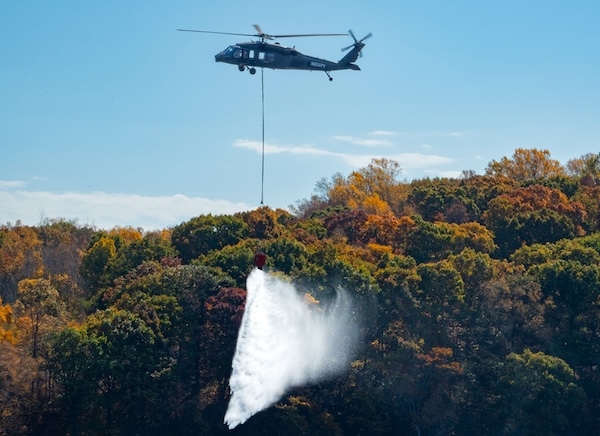
Sikorsky and Rain successfully demonstrated how an autonomous Black Hawk helicopter can be commanded to take off, identify the location and size of a small fire, and then accurately drop water to suppress the flames. Performed Oct. 29 at Sikorsky headquarters in Stratford, the Rapid Wildfire Response Demonstration showed the effective fusion of Sikorsky’s MATRIX™ flight autonomy with Rain’s wildfire mission autonomy system to suppress a fire in its incipient stage.
Maxwell Brodie, Rain CEO commented: “Government agencies, aerial firefighting operators, and investors are coming together to learn and see how both flight and mission autonomy can help prevent high intensity million-acre wildfires. Wildfires cost the United States over $390 billion annually, and multiple risk factors are set to grow up to 30% by 2030. We look forward to demonstrating to lawmakers how autonomous aircraft can stop fires from breaking out, or continue the fight into the night, and in turbulent and smoky conditions, where crewed aircraft wouldn’t venture.”
Igor Cherepinsky, director of Sikorsky Innovations’ rapid development/prototyping group stated: “With Rain’s wildfire mission software loaded onto the aircraft and a tablet, wildland firefighters in the field could deploy autonomous Black Hawk or Firehawk helicopters to search and attack wildfires before they spread out of control. Having worked closely together for over a year, our two companies are ready to demonstrate the joint capability in more dynamic conditions chosen by firefighters.”
Genevieve Biggs, director of the Gordon and Betty Moore Foundation’s Wildfire Resilience Initiative and Special Projects program said: “This technology that we used to think of as being on the horizon is here now, no longer just a figment of our imagination. It’s humbling to see this impressive machine, and think about the improvement in safety that becomes possible when you're layering into wildland firefighting an autonomous operation, as Rain and Sikorsky have been able to do together.”
During the 30-minute flight demonstration, guests used a tablet to command the Black Hawk aircraft to take off, search and find the fire, then drop water from a Bambi Bucket slung 60 feet beneath the aircraft. Each of three successive water drops extinguished a 12-inch diameter propane-fueled fire ring emitting a 3-to-6-inch-tall flame, demonstrating the precision of the Rain fire perception and targeting capability. The Rain system also rapidly adjusted the flight path to account for an 8-to-10-knot crosswind during each water drop.
Representatives from NASA, Federal Emergency Management Agency, Defense Advanced Research Projects Agency, Los Angeles County Fire Department, Orange County Fire Authority, and the philanthropic and impact investment community witnessed the demonstration as part of a two-day wildlands firefighting meeting to discuss autonomy. Sikorsky safety pilots in the Black Hawk cockpit monitored the flight controls, but were hands-off until the aircraft landed. Representatives attending the demonstration provided real-time input and observations to the Rain and Sikorsky teams.
Embraer has appointed FL Technics as an Embraer Authorized Service Center (EASC) for its commercial aircraft fleet in Lithuania. The designation covers the E170 and E190 aircraft, further strengt...
Western Aircraft, an Authorized Pilatus Center and Greenwich AeroGroup company, is celebrating a trio of significant achievements in 2026 that underscore its enduring partnership with Pilatus. The mil...
From the forests of Canada and the Pacific Northwest to the fire-prone landscapes of Florida, Daher Aircraft’s Kodiak and TBM platforms are playing an increasingly critical role in wildfire resp...
The acquisition marks an important step in SITA’s evolution from a provider of aviation connectivity solutions to a driver of smarter operational decision-making. By combining Flightscape’...