


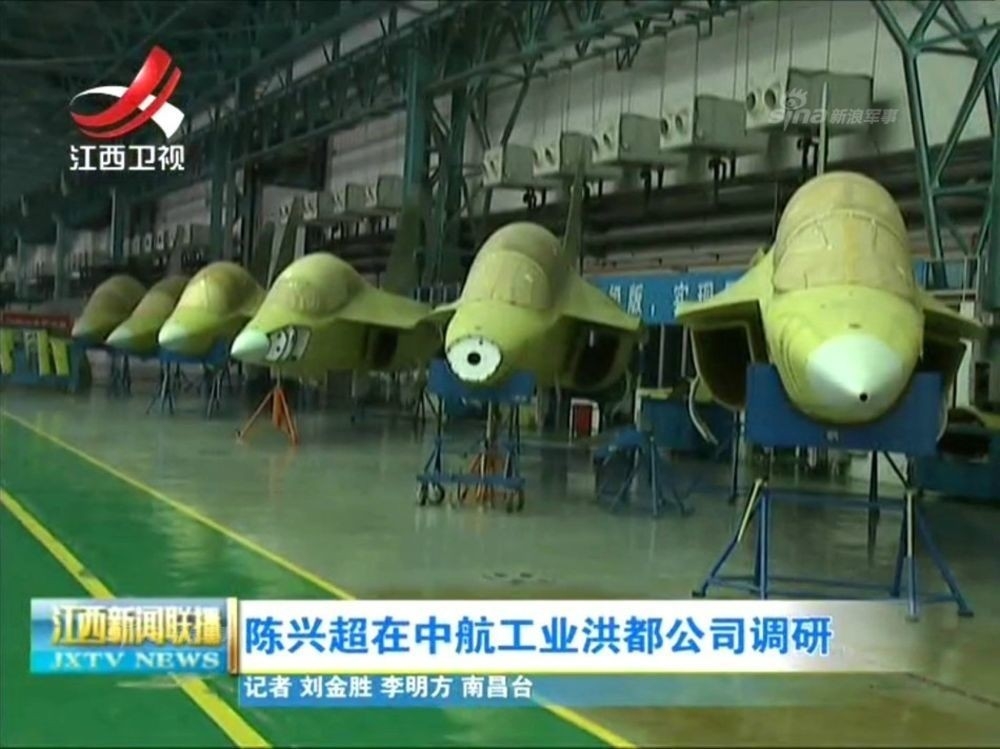
Hongdu Aviation Industry Corporation is gearing up for mass production of the JL-10, for both Chinese and foreign customers.
One of the largest aerospace contracts in the world right now is T-X program, an effort to replace all of the United States' T-38 trainer jets—a.k.a. the aircraft used to train fighter pilots. When counting the potential buys on the foreign export market, some 1,000 new jets are planned for this program.
But the T-X won't be alone. China is playing in the same sandbox with its L-15 (JL-10 in People's Liberation Army Air Force service), an advanced training aircraft undergoing mass production at the Hongdu Aviation Industry Corporation in Nanchang. With this plane, China is quickly building up a supersonic jet trainer force, as well opening up its own export market.
The L-15/JL-10 is a lead-in fighter trainer (LIFT), which is what training pilots transition to after starting off on subsonic propeller and jet aircraft. This means it is the final plane that Chinese fighter pilots will fly before taking flight in frontline fighters like the J-10, J-11, and stealthy J-20.
The planes have a maximum takeoff weight of 9.5 tons and uses a three-axis fly-by wire system that helps simulate the flight parameters of most modern fighters. The Ukrainian Ivchencko AI-222K-25F turbofan engines on its supersonic JL-10 version pushes it to a speed of Mach 1.4. It has tandem seating for two people; the student pilot in the front seat, and the instructor in the back. The advanced avionics on the JL-10 will also help student pilots prepare for the complex digital cockpits on modern Chinese fighters, especially the J-20.

A Success
The JL-10 is quickly becoming a success, as it begins to meet the PLAAF's need for 21s- century fighter training, as well as planning to fill possible PLANAF and foreign orders.
The L-15/JL-10 first flew in 2006 and has already won export orders from Venezuela and Zambia, in addition to equipping the first few PLAAF squadrons. With the PLAAF and PLANAF projected to have a combined 1,200 fourth- and fifth-generation fighters by 2030, Hongdu Aviation will likely have an order backlog for hundreds more JL-10s.

L-15B
The L-15B, a proposed variant of the JL-10, is equipped with long-range air-to-air and air-to-surface attack capabilities, making it a cheap, modern multirole aircraft.
Da Hai
In addition to its training mission, the JL-10 comes equipped with a passive electronically scanned array (PESA) radar that can be used in long-range air-to-air combat, and its three-ton payload can be configured for air superiority and counterinsurgency missions. The flexibility and low cost of the JL-10 means that it could be modified as a low cost close air support aircraft in counterinsurgency and counterterrorism roles. It may also have a broader export appeal, as its basic air combat capabilities make it ideal for countries facing a low threat air defense environment (the South Korea T-50 Golden Eagle has found success in that role).
While it may not be as exciting as a stealthy drone or fighter jet, the L-15/JL-10 shows that that China is not only building a world-class force of combat aircraft, but also all the supporting elements of modern air power.
From the forests of Canada and the Pacific Northwest to the fire-prone landscapes of Florida, Daher Aircraft’s Kodiak and TBM platforms are playing an increasingly critical role in wildfire resp...
Embraer and Austrian Airlines have signed a Component Pool Program agreement to support the carrier’s fleet of 13 E195 aircraft. Under the agreement, Austrian Airlines will gain access to Embrae...
FL Technics Indonesia has successfully obtained EASA Part-145 certification for its Bali maintenance facility, authorising the company to perform maintenance on aircraft registered within the European...
ALSIM is supporting the advancement of pilot training in Malaysia through ADMAL Flying Academy’s acquisition of an AL250 simulator. The addition of the device will enhance the academy’s Co...