


Civil aviation encourages connection and contact by bringing people closer together. It represents a growing need and one that must go hand in hand with sustainable development. Dassault Aviation is one of the pioneers of “green” aviation and devotes a large share of its R&D budgets to it: for the same mission, our Falcon business jets burn 30 to 40% less kerosene than our competitors. We are continuing with our efforts to reduce the specific fuel consumption of our aircraft by taking part in the European Alpha-BIRD alternative fuels program and the CELINA fuel cells program.
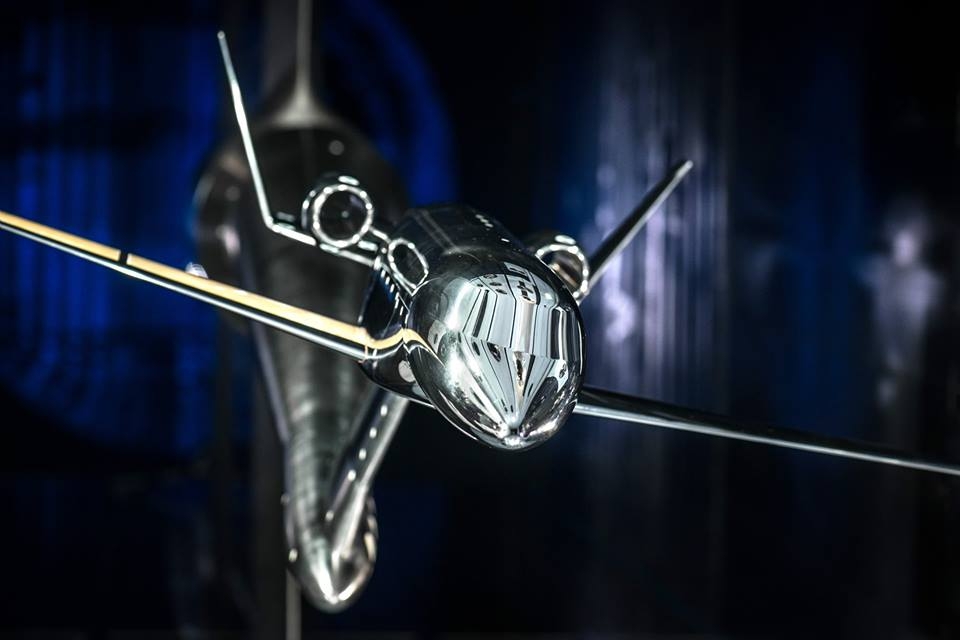
Dassault Aviation quite naturally joined the CleanSky program sponsored by the European Commission and involving the majority of European aeronautical players (Airbus, Finmeccanica, Rolls-Royce, Saab, Safran, Thales,…). The purpose of this unprecedented initiative is to improve the environmental impact of future generations of aircraft (noise, consumption, pollution). We are currently in the first phase, which should be completed in 2016. Dassault Aviation, representing business aviation, is playing a significant role in the “Smart Fixed Wing Aircraft (SFWA)” technology platform. This is preparing the wings of the future with extended laminar flow and load control, as well as silent after-body architectures (masking of engine noise directed towards the ground, see photo enclosed).
In CleanSky, our company is also jointly responsible for the “eco-design” platform, together with the German Fraunhofer research Institute, which is looking to make aircraft manufacturing, maintenance and decommissioning more ecological: less use of resources (water, energy) and of raw materials, elimination of waste gases (CO2, VOC) and liquids (cutting fluid, wastewater). Within this scope, the challenges lie mainly in the field of green manufacturing technologies: composite materials, new lightweight alloys, new machining processes, 3D printing (Dassault Aviation was a precursor and promoter of this industrial technology as early as the 1990s and has been deploying it since the 2000s on the Falcon and Rafale programs; in 2013, a new milestone was reached with application of direct manufacturing to metal parts).
Dassault Aviation is also extensively involved in CORAC, a national program to support research activities considered to be centers of French excellence. This initiative, which was launched following the Grenelle environment summit, brings French aeronautical firms together to work on making lighter airframes, reducing noise levels and developing navigation systems compatible with future air traffic control. More specifically, we are studying five main topics:
This CORAC work is funded 50% by the State – under the Investing in the Future Project (PIA) – and 50% by industry.
Boston MedFlight, the internationally recognized nonprofit provider of critical care transport services, has signed an agreement with Airbus Helicopters for three new H145 helicopt...
Boeing forecasts that global air cargo traffic will double over the next two decades, driving the worldwide freighter fleet beyond 4,000 aircraft by 2045, according to its 2026 World Air Car...
Airbus has launched Alpha Component Solutions, a 50:50 joint venture with Air France dedicated to delivering comprehensive A350 component support services. Jointly operated by Airbus and Air Fran...
Boeing and Lufthansa Technik have extended their long-standing Tailored Parts Package agreement, reinforcing a partnership aimed at enhancing parts availability, simplifying supply...